1979 Ewen High Spring Ball disaster
Stephen King Three Classic Novels Box Set: Carrie, 'Salem's Lot, the ShiningThe 1979 Ewen High Spring Ball disaster is the central catastrophe of the story: a school dance intended as a ritual of adolescent recognition becomes the scene of Carrie White's public humiliation, telekinetic retaliation, mass death, and the subsequent destruction of Chamberlain. Recalled through competing investigations, survivor testimony, journalism, and Susan Snell's later account, the disaster is presented both as a supernatural event and as a collective social failure. Carrie White's latent telekinetic talent reaches its third known eruption under extreme guilt and stress, but the conditions that make the eruption catastrophic have been assembled by classmates, school authorities, damaged infrastructure, and a community that repeatedly misreads the vulnerable girl at its center.
Background and Accumulated Stress
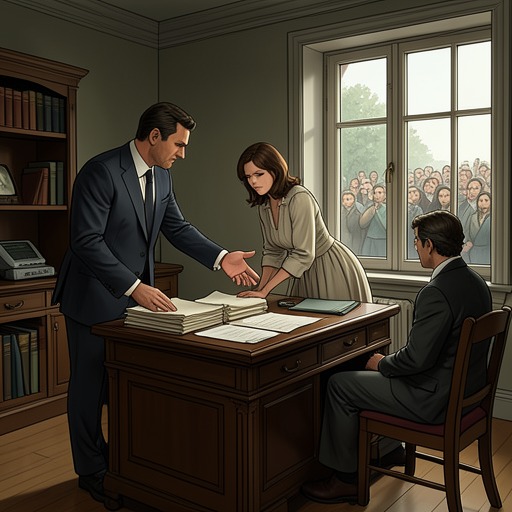
The disaster does not begin at the dance itself. Its deepest precondition is the shower-room incident, when Carrie White experiences menstruation in public and the other girls respond with terror, ridicule, and the repeated command to “plug it UP.” The scene is treated as both a bodily crisis and a social expulsion: the blood that should mark an ordinary passage into puberty becomes, in the eyes of the group, proof of abnormality. The girls' behavior leads to disciplinary action, but the punishment is compromised from the beginning. Rita Desjardin explains that Ewen High School's male administrators do not understand how nasty the act was, and imposes one week's detention in the gym under her own supervision rather than a more serious institutional response.
The incident also reawakens a power that had surfaced earlier in Carrie White's childhood. The documented account in The Shadow Exploded describes telekinesis as a hereditary, usually recessive trait, sometimes called TK, whose manifestations may remain hidden until extreme personal stress brings them to the surface. Carrie White's earlier demonstration occurred under intense guilt and stress; the shower-room humiliation supplies a second such crisis. The account further links the resurgence to both psychological pressure and puberty. On Prom Night, a third stress situation completes the progression, turning a previously concealed capacity into the force behind the catastrophe.
The event is therefore framed as a chain rather than an isolated shock. Carrie White arrives at the Spring Ball carrying the effects of religious abuse, social ostracism, the shower-room humiliation, and the precarious possibility of being treated as an ordinary girl. The possibility is genuine but unstable. Susan Snell later insists that the people involved were children: Carrie White, Christine Hargensen, and Susan Snell were seventeen; Tommy Ross was eighteen; and Billy Nolan was nineteen. Her repeated emphasis that “We were kids” does not erase responsibility, but it places the disaster within a culture of immature decisions, overreaction, cruelty, and underestimation.
The Dance and the Failed Rite of Recognition
At the dance, ordinary school ceremony initially appears to offer Carrie White a different identity. Thomas Everett Ross accompanies her after Susan Snell proposes that he take her in compensation for her part in the shower-room incident. Later commentators dispute Susan Snell's motive and advance a “practical joker” theory, suggesting that Thomas Everett Ross and Christine Hargensen were participating in a plan to bring Carrie White to the Spring Ball and complete her humiliation. The uncertainty surrounding the invitation becomes part of the disaster's moral complexity: the same gesture can be read as atonement, romantic idealism, manipulation, or a cruel trap.
The public vote for King and Queen intensifies the ceremony. Vic Mooney, president of the Senior Class, calls the students to their seats and announces the voting. The result is counted three times, and then he declares, “Tommy and Carrie win. By one vote.” The announcement produces applause mixed with satiric overtones. Carrie White, startled and overwhelmed, experiences the moment as almost unreal, while Thomas Everett Ross is briefly seized by a vertiginous fixation on her. Vic Mooney then announces them as “The King and Queen of the 1979 Spring Ball,” giving the dance its apparent culmination.
The coronation is a temporary and unstable reversal of Carrie White's social position. The girl who had been publicly marked by menstrual blood is suddenly placed at the center of the school community, dressed for admiration and receiving the attention of the entire hall. Yet the ceremony does not repair the earlier exclusion. It converts Carrie White's vulnerability into a public spectacle, so that recognition and exposure become inseparable. The dance therefore functions as a failed rite of passage: instead of integrating Carrie White into the group, it prepares the stage on which the group will repeat its violence.
Blood, Retaliation, and Fire
The decisive humiliation is the pig-blood prank. Carrie White is drenched in blood before the assembled students, and the scene forcibly reconnects the Spring Ball to the shower-room incident. Her memory collapses the two occasions: the earlier blood running down her leg, the shower striking the tiles, the tampons and napkins thrown against her, and the voices urging her to “plug it UP” return inside the new spectacle. The prank gives her “the shower they wanted,” transforming what might have been a school celebration into a ritualized repetition of degradation.
The crowd's response makes the violence collective. Laughter spreads through the gym, and even Vic Mooney is seen laughing although his face is frozen in shock. The sound matters because it supplies Carrie White with the social meaning of the scene: the entire room appears to confirm that she has again become an object of ridicule. The immediate value shift is absolute. The promised dignity of the coronation becomes shame; inclusion becomes exposure; celebration becomes terror.
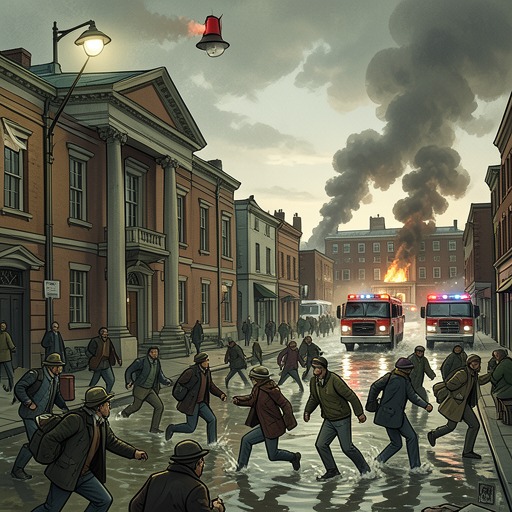
Under this extreme stress, Carrie White's telekinesis erupts. The disaster's supernatural mechanism is inseparable from the physical systems of the school. A fire begins in the electrical equipment of Josie and the Moonglows, spreads to the Venetian boatman mural, and then reaches the backstage accumulation of old uniforms, books, and papers. Thomas Everett Ross is already unconscious on the stage and dies there before the oil tank explodes half an hour later. The school fire thus becomes the first visible form of a retaliation that rapidly exceeds the boundaries of the prank and the gymnasium.
The rescue system fails as the violence expands. The fire report states that hydrants in the area have been vandalized, while water pressure from the city mains between Spring Street and Grass Plaza is inadequate. The disaster is consequently not only an eruption of personal power but a cascade through compromised infrastructure. Human cruelty creates the immediate trigger; telekinesis supplies an extraordinary force; vandalized hydrants, failing water pressure, fire, and delayed response allow the catastrophe to become communal.
Disintegration of Chamberlain
The emergency develops beyond the school. Sheriff testimony records that the first notice of trouble at Ewen High School reached him by radio from Officer Jacob Plessy at 10:21. The information arrives after the crisis is already underway, and the available response cannot match the speed or scale of the destruction. The disaster's chronology is marked by widening failures of communication, transport, firefighting, and public knowledge.
At 12:06 a.m., a Jackson Avenue gas main is opened. At 12:17, an ambulance attendant traveling toward Summer Street throws out a cigarette butt, and the resulting explosion destroys nearly half a block, including the offices of the Chamberlain Clarion. By 12:18, Chamberlain is cut off from the surrounding country. Seven minutes before the gas-main explosion, the telephone exchange had already suffered a complete jam of every town line still operating. The three girls on duty remain at their posts, but they are unable to cope with the implacable calls. The town's isolation is therefore both physical and informational: roads and utilities fail while the outside world is denied a reliable account of what is happening.
Eyewitness testimony conveys the scale of the flight without pretending to exactness. When asked whether many people were walking down Carlin Street, a witness can offer only an uncertain estimate—perhaps thirty, perhaps more—because shock has displaced ordinary observation. This uncertainty contrasts with the later precision of reports, inquiry transcripts, and casualty estimates. The event is first lived as confusion and only afterward arranged into evidence, though no arrangement fully restores what was lost.
Memory, Blame, and Legacy
The disaster produces competing explanations. The White Commission uses Susan Snell as a convenient scapegoat, while David R. Congress's The Shadow Exploded remains, in Susan Snell's judgment, one of the few serious books on the subject. Other theorists try to reduce the catastrophe to a deliberate practical joke centered on Thomas Everett Ross and Christine Hargensen, with some even accusing Susan Snell of active participation. This interpretive struggle reveals a desire to find a manageable human conspiracy in place of a more disturbing combination of bullying, institutional incompetence, supernatural ability, and collective passivity.
Thomas Everett Ross becomes especially contested because his role is so easily converted into a simple causal symbol. One account compares him to a trigger-man in a catastrophe and asks whether he acted knowingly or unknowingly. Yet the available evidence resists the image of a mindless “dumb jock.” Thomas Everett Ross was an above-average baseball player, a varsity athlete from his sophomore year, a straight-A student, a prospective English major, and a writer of poetry. Surviving classmates, including unpopular students who were largely absent from the dance, remembered him as friendly and good-natured. His invitation to Carrie White is therefore presented as evidence of social independence and consciousness, even though it does not make him a saint or release the event from its tragic consequences.
Susan Snell's later narrative returns repeatedly to the fact that the participants were adolescents. The repetition is defensive, ethical, and memorial: it challenges the press, scientists at Duke University, David R. Congress, and the White Commission for explaining the event without understanding the human scale at which it began. “We were kids” cannot undo two hundred deaths or the destruction of an entire town, but it rejects the comforting fiction that catastrophe is always produced by monsters wholly separate from ordinary society. The disaster grows from ordinary people making damaging choices around an extraordinary and increasingly isolated person.
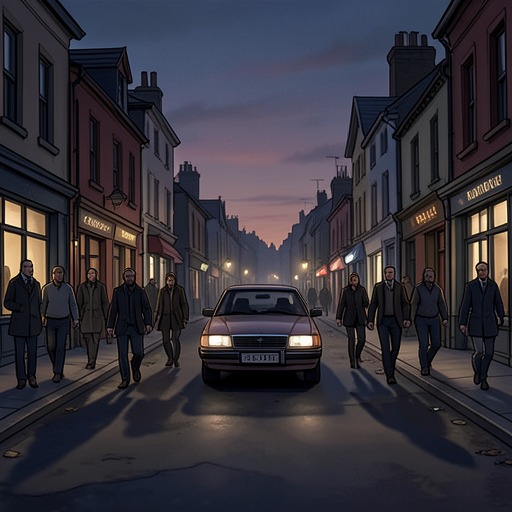
The post-disaster landscape makes that damage visible long after the night ends. Residential streets on Chamberlain's East Side remain, bordered by old oaks, and houses on Morin Street and Brickyard Hill stand neat and undamaged. Yet the pastoral surface lies at the edge of a blackened and shattered center. Many houses carry FOR SALE signs, while occupied homes bear black wreaths on their doors. The event's final significance is thus not exhausted by the fire or the deaths at the dance. The 1979 Ewen High Spring Ball disaster becomes a lasting crisis of social memory: a school ritual becomes a massacre, a town becomes a memorialized ruin, and every later explanation must confront the fact that the catastrophe was both extraordinary in its power and painfully ordinary in its origins.